


In brief
P. van Eijzeren Machinebouw in Borssele used AI to build its own platform that connects the company’s systems. Infodatek Group has been its IT partner since 2022 and provided the secure foundation: the technology, the security and the integrations. In production preparation it saves about a quarter of the time.
- Client
- P. van Eijzeren Machinebouw B.V.
- Sector
- Machinery manufacturing
- Location
- Borssele (Zeeland)
- Services
- IT management, advice on the AI chatbot, a security review of the code and integrations with Microsoft 365
Its own platform that connects the company’s systems, with about a quarter less time spent on production preparation
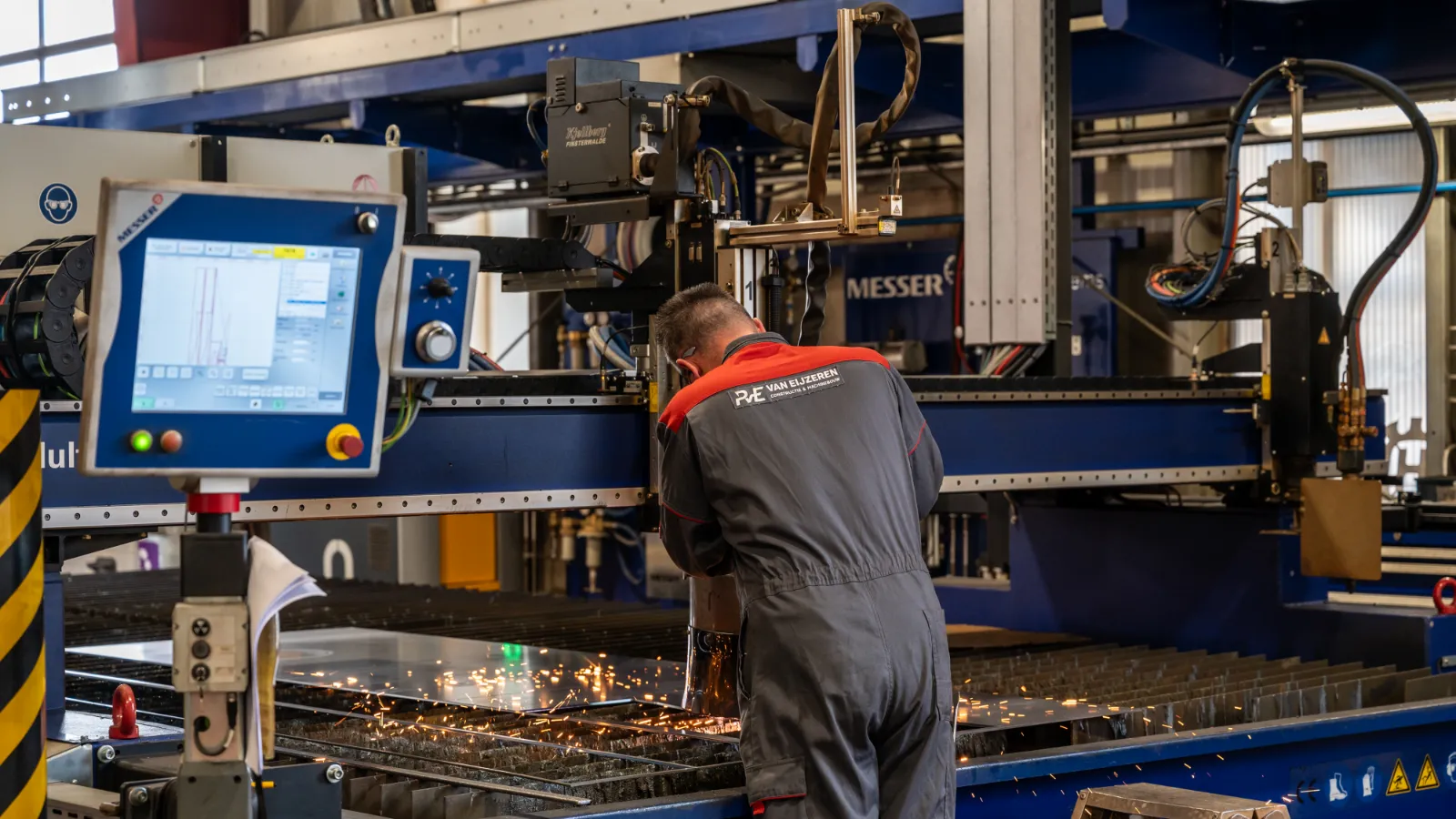
P. van Eijzeren Machinebouw in Borssele builds material handling systems, for example for port companies that unload sand and gravel from a ship, screen it, wash it and transfer it again. It also builds systems for coal, fertiliser and waste streams that need to be separated. This is always custom work, because it depends on the product, the warehouse and the site. The company also makes machine parts for other businesses.
In 2025, owner Peter van Eijzeren started building software himself with the help of AI. The company now has its own platform that brings together the ERP, the CAD and CAM software, HR and the quality systems, including an AI chatbot that stays within the company’s own walls. Infodatek Group, the company’s IT partner for years, helped with the foundation: the technology, the security and the integrations.
A lost template and an hour of work
For the annual plan, Peter had set up an online tool himself. “We thought it worked quite well, really,” he says. Then he accidentally deleted his own template. The supplier could not restore it, so he decided to rebuild it. He used one of the AI tools he had recently been experimenting with, and an hour later it was done.
“In an hour I had actually built that functionality. That’s when I thought: this is really going to change the world.”
Many business owners are at that point right now. Asking ChatGPT a question and getting a short text back is something anyone can do. But making something you would normally ask a programmer or a web designer to do is a different matter. “As a layperson, you can really just let AI do that.” The tool grew into a management tool that the company’s managers use every day.
But where do those documents end up?
Then the questions came. The tool ran online, so where was it actually hosted? On which server, in which country, and what happens if someone gets in who should not be there?
The real problem was the documents. “They end up on some server,” says Peter. “You can simply delete the software you build and it is gone. But the documents are still there.” When it came to connecting systems, things got really uncomfortable. Peter realised that, among other things, personal data and other sensitive business information must not simply sit somewhere online. The platform has to be secure.
“It’s fantastic, just not in this way.”
Many business owners who start with AI end up at this point: the tool works, but nobody can explain where the data is stored and who can access it.
One extension lead for all your systems
The idea of a platform was not new. When the new ERP package was introduced in 2023, the conversation had already turned to a single place where all software can easily exchange data. “Think of it as an extension lead that you plug everything into,” says Peter. You can then build your own tools on top of it, so that everything stays one whole.
Then the question was mainly: how? That is exactly where it stops without help. You have to be able to log in with Microsoft, and security has to be right. “You have to keep the front door closed without leaving the back door open,” says Peter. “And if one colleague logs in, they must not be able to look up another colleague’s salary via a workaround.”
Infodatek Group had been Van Eijzeren’s IT partner for several years and had just delivered a new server. Peter contacted Walter, his account manager at our company. Walter was enthusiastic right away and we set to work together. With one of our software engineers and Van Eijzeren’s internal project leader, a mechanical engineer who also led the ERP implementation, the technical foundation was laid.
Build it yourself where you can, get help where you need it
Van Eijzeren builds most of it itself, and that is the heart of the collaboration.
Everything functional, meaning the tools that fit exactly with the way the company works, Van Eijzeren builds itself. As soon as things get technical, our software engineer steps in: logging in with Microsoft, sending email from the platform, security and the programming work that you, as a non-programmer, cannot get to grips with.
Peter explains why this split works. In his view, an external party first has to get to know the company and the way it works, and that takes a lot of time. Your own people know your processes and products better and can therefore automate better. So you do not always need to outsource everything. The functional side stays with Van Eijzeren, while the technical support comes from Infodatek.
“The abstract programming we leave to Infodatek. The really functional things we build ourselves.”
In addition, we advised on the AI chatbot, carried out a security review of the code and investigated how to make the platform securely accessible from outside the company network. This is also relevant to the Cybersecurity Act (NIS2).
A quarter less time in production preparation
The platform is being rolled out step by step. Production scheduling, production preparation and purchasing are already using it. Engineering will follow later.
The tangible gain is in production preparation. A customer sends a series of drawings, sometimes twenty at once. They contain everything: material, quantities, part numbers and other requirements. What used to be done by hand is now largely automated.
The platform reads the drawings, creates a bill of materials and checks whether the part has been made before, with that material and those operations. It then looks at the schedule: does it fit on that machine, when is it free and does it fit within the time? If the part is too large, it looks for another machine. According to Peter, that saves about a quarter of the production preparation team’s time.
The platform is still in its test phase, so human checks are deliberately kept in place to iron out any teething problems. “Technically, you could have a customer request analysed fully automatically and have a quote drawn up from it. But we are not doing that yet.” If the platform eventually makes fewer mistakes than a person, those checks can be dropped.
A chatbot that suggests an improvement itself
An example from practice shows how the platform grows with the company. A customer says they will not pay an invoice because the goods have not been delivered yet. Normally someone would call the planner. This time Peter put the question to the chatbot. It replied that it has no access to the sales invoices and therefore does not know which order belongs to it.
The chatbot then suggested adding an item to the improvement list itself. Once a week, the project leader goes through that list and decides what gets implemented. For every change, the system checks that nothing else breaks and that nothing is being built twice. It also documents the code properly, so that a software engineer can still make sense of it two months later.
“We really needed Infodatek for that.”
That is the difference between a bit of tinkering and software that keeps working: the ground rules. Do this as a layperson and you build something that looks great on the front end but can falter behind the scenes, or not work at all.
“With Infodatek’s expertise behind us, we as laypeople are able to build software that works well.”
Peter van Eijzeren, owner, P. van Eijzeren Machinebouw
How to start safely with AI: Peter’s advice
Peter would certainly recommend it to other business owners, provided four things are in place.
Involve your IT partner. Peter would not have thought of this himself without his IT partner. “If Infodatek had not been our IT partner, I would not have thought of this at all.” Make sure security and management are properly arranged from the start.
Find an internal champion. You need someone in-house who understands the technology and enjoys it. At Van Eijzeren that is the project leader, who also led the ERP implementation and knows the whole engineering process. Not every engineer enjoys this, and without that it goes no further.
Make sure the owner and management are on board. Without the support of the owner or management, it does not work. Owners who only weigh up an annual salary plus costs tend to give up early. “Because you cannot put an exact figure on the return.”
Make sure the internal story holds up. Explain to your employees what the benefit is, for the company and for themselves. Otherwise there is a good chance they will ignore it.
Similar case studies
An IT partner close by and a smooth switch
Feyter Group in Terneuzen switched to Digital Care Pro and now has one IT partner for 5 companies, with an engineer on site.
Read the case
At Infodatek, they go one step further
Draftec handed its IT management and the supply of hardware and software to Infodatek Group. The result: IT in balance and short lines of communication.
Read the case